We just got back last Thursday from 34 days of traveling across the Atlantic, northern Europe and several Baltic countries. We were able to visit places
I’d always wanted to see (like England, Denmark, Sweden), places I’d never given much thought to (Azores, Belgium, Finland), and places that were not
even open to visiting when I was younger (Russia, Estonia, former East Berlin), plus a few other places. We had wonderful weather and a great time.
I’d always wanted to see (like England, Denmark, Sweden), places I’d never given much thought to (Azores, Belgium, Finland), and places that were not
even open to visiting when I was younger (Russia, Estonia, former East Berlin), plus a few other places. We had wonderful weather and a great time.
We flew to Fort Lauderdale on April 21 and boarded the MS Zuiderdam the next morning. We had been on a sister ship before (Westerdam), but were
pleased to see the recent dry dock to the Zuiderdam included upgrades to large flat screen TVs with streaming movies, TV shows, news and other features
that are nice for a trip with lots of sea days. We started out with two sea days travel to get to Bermuda. There we took a bus around the bay to the capital
city of Hamilton. As we started to walk around we found the city hall which had a sign advertising a free walking tour lead by the town crier. He was outfitted
in traditional English dress with a tricorner hat and large bell. We visited the cathedral and the legislature as well as seeing many parts of the city. We took
the ferry back to the Royal Naval Dockyards where our ship was docked and looked around at the shops housed in the old buildings there.
 |
| In the Bermuda Legislature |
 |
| Royal Naval Dockyards, Bermuda |
After Bermuda we had four sea days to cross most of the Atlantic Ocean. Our routine was similar from day to day on the sea days: morning lectures on
various topics, cooking demonstrations from America’s Test Kitchen, BBC Earth shows. Afternoons were usually a trip to the gym, swim or walk the
promenade, a movie and dinner. The evenings were filled with entertainment from shows on the main stage from musicians, comedians, or a fantastic
juggler. Then off to the BB King Blues Club for a great band and sometimes Lincoln Center Stage for a string quartet and piano, or Billboard Onboard for
piano/singer duet of pop music.
 |
| Street in Horta, Azores, Portugal |
 |
| Scrimshaw carvings |
 |
| Scrimshaw etchings |
destination. We were only the third ship there this year since the Azores are only on Transatlantic itineraries. We visited the Scrimshaw Museum.
Scrimshaw is etching or carvings that sailors would do on whale bone or teeth as their pastime at sea. They were very beautiful and had amazing detail.
Next, Chuck had a gum infection bothering him for a couple days, so the ship arranged a taxi to a local dentist for us. Another couple came along that had
a loose bridge. So for a 5 Euro taxi ride and a 10 Euro consultation, we were taken care of. We were quite pleased with that, about $20 total, which would
have cost many times more at home.
The other Azorian island we visited was Sao Miguel, docking at Ponta Delgada. This was an amazingly beautiful place. We went on a tour that another
passenger had arranged (she’d been there on four previous cruises) that took us all over the island. The first of two main destinations was Sete Cidades.
It is the caldera of a volcano with two beautiful lakes inside. One lake is green and the other is blue, but the weather was overcast just enough to make the
colors look about the same. Still it was a beautiful view, a magnificent setting for a town on the lakesides. From there we headed toward the other end of
the island to another volcano caldera. Next to the lake in this one is an area that is used to bury large pots of food so they are cooked by steam rising from
the volcano. The restaurants or individuals can take them out there at 5am to be buried, then around noon they unearth them. After watching them dig up
our pot we headed to the restaurant that serves the contents - beef, chicken, pork, vegetables, potatoes and yams. It was quite tender and good. We also
had local passion fruit juice and pineapple for dessert. Then we visited a hot springs area and tea plantation. The whole island was beautiful because of
the green fields with grazing cows and many flowers everywhere.
 |
| Sete Cidades, Azores |
 |
| View from Ponta Delgada |
Northern European Coast
Back to sea for three more days on our way to Southampton, England. The ocean was a bit rougher for the first couple days. It didn’t really bother us
at all except it made it difficult to walk in a straight line; everyone looked like they were failing a sobriety test. As we got into the English Channel we began
to see other ships for the first time in many days. In Southampton we shared a taxi tour with three other couples (arranged ahead of time on the cruise
critic forum) to Stonehenge. Of course it's just like the pictures, but maybe not as large as I expected. Still, it is an amazing sight. It was quite crowded
(it was a “bank holiday” and the weather was gorgeous) but it's protected so you can't go right up to the stones, making it easier to photograph without
people in the way. The countryside around there is beautiful green rolling hills. Then we went to Salisbury, which is a classic English medieval city with
some fantastic old buildings. We had a couple hours there, so we started with lunch; Chuck with traditional fish and chips, me with a shepherd’s pie.
Both were excellent. Then we just walked around enjoying the atmosphere. People were quite friendly, a lady even told Chuck she loved his accent, haha.
I loved hers! We also walked around the Cathedral grounds and courtyard. Engraved in the rocks of the pathway and the walls are memorials to people
from the late 17 and early 1800’s. After that we drove through the New Forest area, a protected area where horses, sheep and cows are allowed to roam
free. There are also nice country homes within the forest area.
 |
| Stonehenge |
 |
| Chuck in Salisbury |
 |
| Salisbury Cathedral |
The next day we arrived at the port of Cherbourg on the French coast. From there we went with another tour group to see the D-Day beaches. First was the town of Sainte Mere Eglise which was the first town liberated by the Allies on D-Day and was strategically important to cut off German supply lines. Paratroopers parachuted in at great peril, many were killed. There's a great story about one getting his parachute caught on the church steeple, they have a dummy up there now to show where it happened. We went to the Paratrooper Museum there that has lots of history and many artifacts from small items to large gliders that were used. Then we stopped at a French bakery to buy sandwiches on wonderful French bread. Continuing on we went to Pointe du Hoc where the Army Rangers scaled the cliffs under heavy Nazi fire. The landscape is full of craters created by Allied bombing and broken concrete from the Nazi bunkers, a couple of which you can go in. The views of the ocean were breathtaking. Our French guide, who was from a small town in the area, told us about how her grandparents had run inland to avoid the bombing. Her grandmother wanted to go to the church but grandpa thought inland would be safer. She showed us the picture of the church which had been bombed out. Many French civilians were killed in the assaults, but the French people were grateful to be liberated after four years of Nazi occupation. From there we headed to Omaha Beach where the American troops landed in large numbers and many more were killed. The beach is four miles long with a big memorial at the center. Lastly we visited the American cemetery with its many rows of white crosses and some stars of David where about 40% of the soldiers are buried. Families had the option to have their loved ones buried there or re-interred in the U.S. that's why less than half of those who gave their lives are buried there. There are still a lot of graves along with some beautiful memorials.
 |
| Church at Sainte Mere Eglise (notice paratrooper caught on steeple) |
 |
| In Paratrooper Museum |
 |
| German Bunker at Pont du Hoc |
 |
| Cliffs at Pont du Hoc |
 |
| Memorial at Omaha Beach |
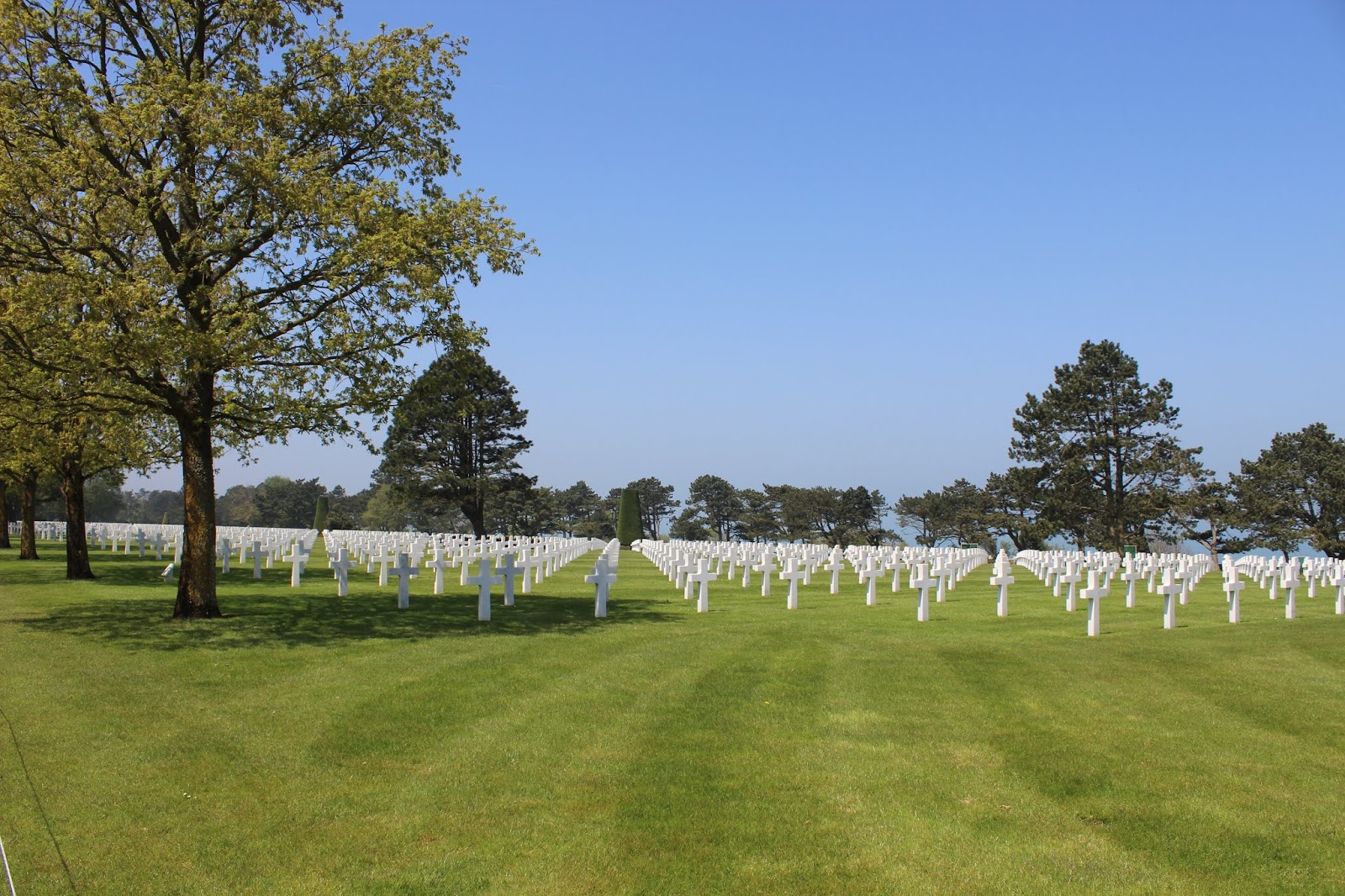 |
| Normandy American Cemetery |
The next day our stop was in Belgium at the port of Zeebrugge. We taxied with a group to the city of Bruges, which was beyond amazing. It is like
being in a medieval fairy tale of winding cobblestone streets, canals and old brick buildings. From the central market square we went on a two hour
walking tour of the city where we learned about the rich history that dates back to the 1200’s. It is one of the best preserved towns in Europe because
it did not get bombed in World War II because Hitler liked the town. Of course we also had to sample the food Belgium is famous for - some Belgian
waffles with strawberries and cream and some fine Belgian chocolate. In the central area there are a multitude of chocolate shops and waffle cafes,
all of which looked amazing, and what we ate was wonderful. We wandered around the maze of streets until our feet were aching, but loved every
minute of it.
 |
| Bruges Canal |
 |
| Bruges Market Square |
 |
| Bruges houses |
From there we sailed on to Amsterdam. We had tickets for the hop-on-hop-off bus and boat, so we got on a boat that would take us to the stop at
the Anne Frank house. I had bought tickets two months in advance, online, which is the only way you can get in there. We got there right at our
appointed time, luckily, so we were able to get right in. No photos are allowed inside. First you go through an area that has photos and information
about the Frank family. Then you go through the actual annex where they and another family lived for over two years. It is very sobering to see the
small area that 8 people lived in, unable to make noise in daytime or ever go outside. I had read her book, “Diary of a Young Girl” when I was about
her age, 14-15. I’d forgotten that they knew about D-Day and hoped to be rescued soon when they were discovered. They were all sent to
concentration camps, and only her father, out of all eight people that were in hiding, survived the war.
 |
| Amsterdam canal |
 |
| Amsterdam windmill |
After leaving there, we took a hop on bus and later another boat to tour the city and its wonderful canals. While Amsterdam is an interesting
city with people riding bikes everywhere, it didn't seem as clean as the other places we’d visited. It was also very busy making it slow to get
around, so we ended our time by walking around to see local businesses and buildings.
We had one sea day traveling north to Copenhagen. This was the end of the transatlantic portion of the cruise, and about ⅔ of the
passengers disembarked there. Several we’d become acquainted with were heading other places in Europe, often because they had done the
Baltics before. We had a day in Copenhagen knowing we’ be back in ten days to spend more time. So we just walked around the Nyhaven
port area, the pedestrian shopping street, and by Rosenborg Castle. We also ate some excellent pastries. In a couple days I’ll post about the
second half of the trip; need to edit photos first (I shot over 1100 pics).
 |
| Nyhaven, Copenhagen |
 |
| Rosenborg Castle |


