Wednesday, August 28, 2019

Road trip - Ohio to Florida

This year we did sort of a double trip; first a road trip and then a cruise.  So first I’ll write about the road trip portion. We started by flying to Cincinnati
where we rented a car.  We were there to visit Chuck’s relatives that live in Northern Kentucky. We visited a couple cemeteries where his mom,
grandma and other family members are buried.  We also had a fun get together with several aunts, cousins and his brother that he had not seen in
many years. We met at Pelle’s Cafe in Silver Grove, Kentucky, that is owned by a second cousin of his.  After leaving there, we headed south
stopping in Louisville, KY. We visited Churchill Downs, home of the Kentucky Derby. They have a tour and an excellent museum that has exhibits
about the horses, trainers, jockeys, and owners as well as history of the races.  We also went to the Louisville Slugger factory. The museum is
small, but the tour was very interesting; everything you could want to know about baseball bat production. For instance, they have their own forest,
and major league players often pick the wood pieces they want for their bats.
Cincinnati Sign Museum
Churchill Downs
Louisville slugger factory
The next day we went to the birthplace of Abraham Lincoln and Lincoln Museum in the nearby town of Hodgenville.  From there we went to Mammoth
Caves National Park. It was a good place to tour because it was cool underground but very hot above ground. It is huge (over 400 miles of passages).
We did the domes and dripstones tour. The last part was beautiful, but overall it’s not as spectacular as Carlsbad Caverns. We ended that day arriving in Nashville, with tickets to the Grand Ole Opry.  The evening’s headliner was one of our favorites: Carrie Underwood. In the morning we headed to The Hermitage, the home of President Andrew Jackson.  He was a rags to riches success story, unfortunately he profited because of ownership of slaves. After the house tour we strolled the grounds and saw an interesting demonstration on how duels we actually conducted in Jackson’s time.  Then we drove in to downtown Nashville, which was very crowded. We stopped at a farmer’s market and an old auto factory (Marathon Motors) that is now shops in a cool old building. The next day we went out to the Stones River National Battlefield at Murfreesboro.  Even though it is not as well known as many other Civil War sites, it was a decisive, significant battle. Besides being a very bloody battle (6th costliest in casualties) it was fought at a critical time, between December 31, 1862 to January 2, 1863. This was when the Emancipation Proclamation was to take effect, so a Union victory was very important for advancing Lincoln’s cause.  From there we went to Franklin to visit the Carnton Plantation. I particularly wanted to visit this site after reading the historical novel “Widow of the South” about the events that took place there during and after the Battle of Franklin in November 1864. The home was used as a hospital and had been filled with hundreds of casualties. You can still see the blood-stained floor where the doctors worked as they did amputations on injured soldiers.  The lady of the house, Carrie McGavock, later used two acres of their property to create the largest private cemetery in the country from the hundreds of soldiers that died there and never returned to their homes.  
Lincoln family cabin (Abe's birthplace)

Mammoth Caves National Park

Andrew Jackson's Hermitage

Marathon Motors

McGavock Confederate Cemetery

Carnton plantation
We’d spent so much time exploring the history in the Nashville area that we ran out of time to do more of the city highlights, so we might have to go back sometime.  The next day we were headed to Gatlinburg, Tennessee. Along the way we stopped at a couple cemeteries where ancestors of mine were buried. One was my great-great grandfather who had served as a Confederate soldier.  The drive into the Great Smoky Mountains was beautiful; the area is so green. Gatlinburg itself, although in a beautiful setting, is a major tourist trap. You know that for sure when there are three different Ripley’s attractions.  We walked along the main street and enjoyed some street performers and checking out the many shops. We spent the night there, then continued through the mountains to the coast, destination Savannah, Georgia. We fell in love with Savannah when we were there in 2013 because of its beautiful old houses and plazas.  After a stop at the Seafood Shack we walked about five miles along the riverfront and through the city’s plazas. We stayed in the 17hundred90 Inn which was really nice. I heard talking outside our window in the evening, and looking outside I discovered the hotel in on the ghosts and graveyards tour. I waved at the people to let them know I was still alive, haha.  

Our next stop was Jacksonville, Florida.  The purpose of that stop was to do laundry and go to Costco.  In the morning we stopped in St. Augustine,
Florida, the oldest city in the US.  We visited the Castillo de San Marcos, which is the largest and oldest (late 1600’s) masonry fort in the US.  We
walked around the historic district and then headed for Port St. Lucie. We drove past Cape Canaveral and down the coastal route and got pounded
by the heaviest rain I’ve ever seen.   The next morning we checked in our rental car at the Fort Lauderdale airport and then boarded the Caribbean
Princess for the next part of our journey.
Savannah cotton exchange

Forsyth Park fountain

17hundred90 Inn

Castillo de San Marcos

Monday, February 18, 2019

Southern Caribbean and Panama Canal Cruise

For this year’s winter get-away, we did a 10 day Southern Caribbean cruise that included a Panama Canal turn around.  We left from Fort Lauderdale, Florida,
and sailed for two days to get to Aruba. Originally we were supposed to go to the cruise line’s private island in the Bahamas, but a rough storm caused the
captain to skip that stop.  We were happy (since we’d been to their island before) to get to Aruba earlier, giving us time to see the town before leaving on a
snorkeling excursion. Aruba was originaly a Dutch territory, so you can see the Dutch influence in the names and buildings.  We passed Fort Zoutman that
is now a historical museum, but didn’t go in. After a little shopping in the main area of Oranjestad, we joined our snorkeling boat that took us to the end of
the island where the bigger resorts are located. The snorkeling was not the best that day; not the clearest water nor large variety of fish.  But we did get
to swim by a sunken ship of the World War ll era. I don’t think there are lots of places to see a ship in that shallow of waters without scuba diving, so it was
interesting. We also enjoyed the warm sunshine!
Fort Zoutman

Orjenstad shopping plaza
Our next stop was Curacao.  We had not booked an excursion there, but just opted to walk around the town.  The island, also formerly a Dutch colony, has
a waterfront that was reminiscent of the Nyhaven area of Copenhagen with its brightly painted buildings and styling.  We walked by a fish market where
the fishermen sell their fish right next to their boat in the canal. There was also a big produce marketplace, and of course plenty of retail shops.  The
port area has an entrance with old walls from a fort.
Willemstad riverfront

Curacao port

Marketplace

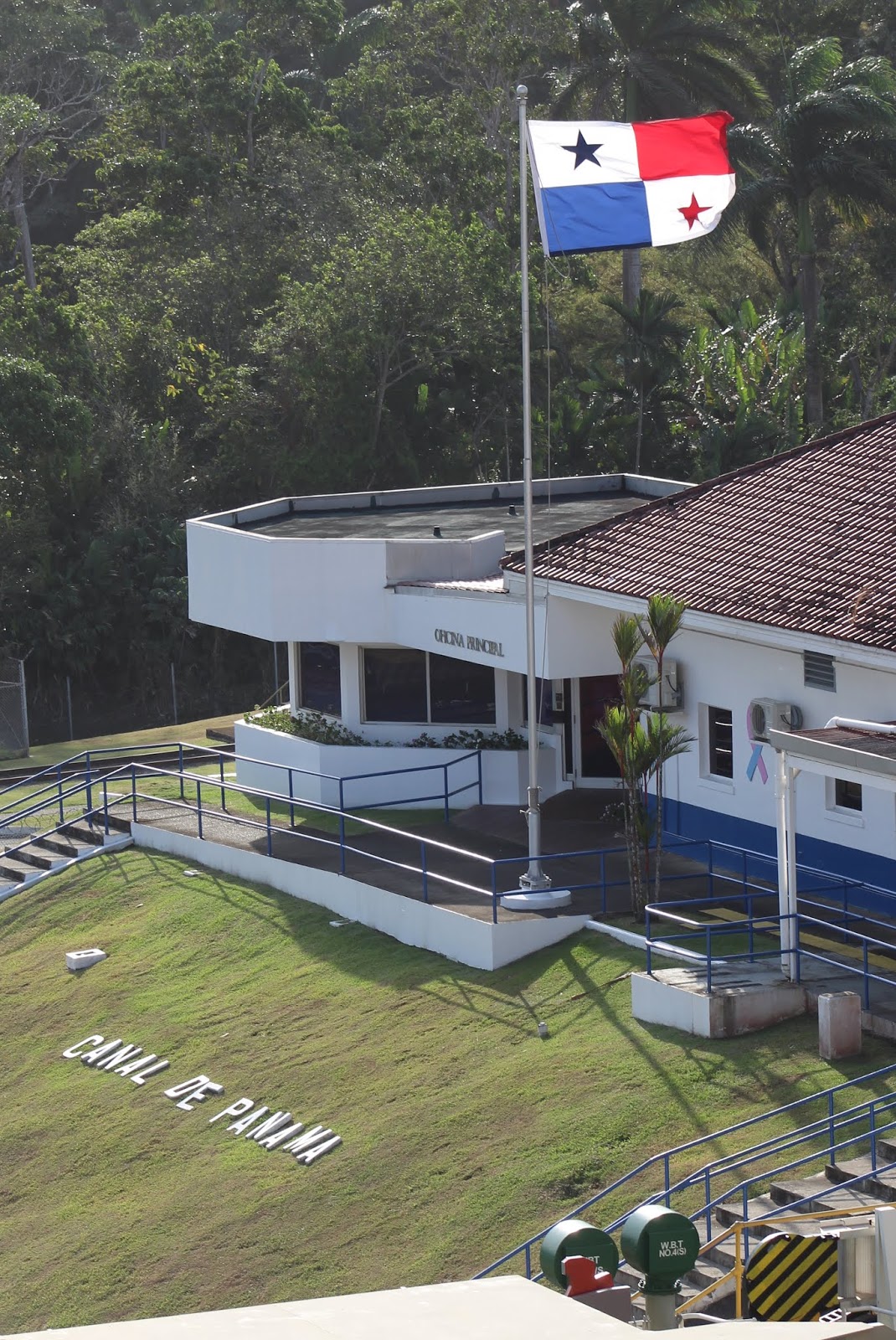
After another sea day we arrived at the Panama Canal.  There are three locks going into Gatun Lake from the Caribbean side.  A Panamanian captain takes
control and they hook the ship up to locomotives (called “mules") that  guide the ship into each lock. Once inside a lock, the back gate is closed and the front
gate opened to let the water level raise the ship about thirty feet (all done by gravity and water flow).  When this is completed, the ship moves ahead into the
next lock and the same process is completed to raise the ship again. After the third lock, the ship sails into Gatun Lake, a huge man-made lake.  This lake
was made by damning the Chagres River and provides the water for the lock system. On a full transit the ship would sail through the lake and exit by
the three locks on the Pacific side, a process that takes 8 to 10 hours total.  We exited the ship from the lake to take an excursion into Colonial Panama to
see the old city (plus views on modern Panama City) and go to the visitor’s center at the Miraflores Locks. It takes about 90 minutes to cross to the Pacific
side by bus (about 50 miles), the only place you can go from Atlantic to Pacific in that short a time!  Along the journey we saw everything from shacks on
hillsides to a beautiful city of man high rise buildings. The colonial section of the city had old Spanish buildings and churches that were reminiscent
of San Juan, Puerto Rico. We walked around the area, then headed to the Miraflores Locks visitor’s center. There is a museum plus a great viewing area to
watch the locks in operation as ships pass through.  We could see how smaller ships and boats are put in the same lock as a larger one when they want
passage. Their fees start at $2000, while large ships pay several hundred thousand dollars, depending on size. We could also see where the new
locks are (there was a large container ship in one) that opened in 2016 to accomodate much larger ships, as big as an aircraft carrier. Then we met our
ship that had exited the canal and docked in Colon.  We were happy to just drive though Colon and get on the ship because Colon is an extremely dirty,
run-down city that didn’t look at all safe to walk around in. That was a bit surprising since it is a big port at the entrance to the Panama Canal.
Welcome to the Panama Canal

Ship entering first lock

View of second lock

Old church in Colonial Panama

Street in Colonial Panama

View of Panama City

Smaller boats sharing lock with ship

Large container ship in new lock
Our last stop on this cruise was Puerto Limon, Costa Rica.  We booked and excursion to go zip-lining in the rainforest there.  We took a bus along a
highway that had truckyards full of containers for companies like Dole and Chiquita that export bananas and other produce from the port.  Within half
an hour we were in the rainforest and to our destination. After being strapped in harnesses and helmets and receiving some instruction, we were up in
the trees ready to begin.  I thought it was awesome from the very first of the twelve cables we did, but Chuck took two or three to get past his nervousness.
They start you with shorter distances, then you get some pretty long rides.  At each platform you’re hooked onto a cable around the tree until your turn to
hook onto the next cable. At one platform we saw an awesome sloth slowly climbing along a tree limb! Some people also saw tree frogs but I didn’t see
any.  Did I mention that the rainforest was beautiful and the whole experience was amazing? It was - I definitely recommend it; nothing scary or strenuous
about it.

Our return to Fort Lauderdale took two sea days, then we hopped on a plane back to Salt Lake.  We left the pleasant 80s of Florida to arrive at the end of one
of the worst snowstorms in many years.  It was actually a snow day with closed schools, something that is very rare here. Thanks to our son, Jeff, for making
the slow trek to the airport to pick us up and get us home safely!
Costa Rican rainforest
Me on the zipline

Chuck zipping along

It was lots of fun!

Wednesday, June 6, 2018

Baltic Cruise and Copenhagen


This is part 2 of our recent vacation where we visited Scandinavian and Baltic countries:
    After another sea day we arrived in Tallinn, Estonia.  We were able to walk from the port to the old town area, a UNESCO World Heritage site.  The old part is a gated city with cobblestone streets and lots of charm. It's almost as quaint as Brugge, which is still our favorite port.  We spent the day walking around and doing a bit of shopping. We also enjoyed a pastry snack, planning to eat a meal back on the ship.
Tallinn Town Square

Door in Tallinn
Town Hall history


Entrance to the old city

On to St. Petersburg!   We had arranged a tour through a Russian approved tour provider, so that included the visa requirement which otherwise is difficult and expensive.  Still, their passport control check was very slow like they expect all these cruise ship tourists to be a bunch of spies in disguise. The first day we began with the Hermitage Museum for a couple hours.   They say that if you spent just a few seconds looking at each item they have it would take several years to see it all. We saw works from Rembrandt, Michelangelo and on and on, so many I can't remember. But I was just as awed by the buildings themselves (there are several interconnected buildings).  They were formerly a royal palace, so they were extremely ornate. After that we went to lunch at a restaurant where we had borscht and chicken Kiev. I’d never tried borscht before and I quite liked it, I’ll have to find a recipe when I get home. Then we drove out to Pushkin Village where we toured Catherine’s Summer Palace.  Although it was only used three weeks per year, it is enormous and very ornate. It, like many of the Russian palaces and churches, had been used by the Nazis and heavily damaged during World War II, but has been extensively restored to its original looks. Luckily many of the decorative statues were buried before the Nazis arrived, so they were dug up and put back after the war.  When we returned to the ship, passport control was once again very slow.

    The second day began with a trip on the subway.   First you go down the longest escalator I’ve ever seen, like four or five stories down at once. The section of subway we rode actually took us under the Neva River.  I think they want to show it off to us because it was so clean and efficient that it puts any other subway I’ve ever ridden to shame, especially the New York City system.  After that we took a canal boat tour up the Neva and through some smaller canals. Then we drove out to Peterhoff to see the fabulous gardens and fountains there. Did I mention that we had fantastic weather, about 80 degrees and sunny every day?    They said that St. Petersburg gets about 60 days of sunshine per year, and we got two of them while we were there. We had lunch at another nice restaurant, chicken Kiev again (I thought we were supposed to have stroganoff one day). Then we headed back into town to see St. Isaac’s Cathedral, absolutely gorgeous, and the Church on Spilled Blood.  Both are Russian Orthodox. The later is all beautiful mosaics on every wall. It was built on the spot where Nicholas II was assassinated, hence the spilled blood. The guide told us that after the Russian revolution, they began fill it with gunpowder to blow it up and get rid of memorials to the czar. But World War II was beginning so they decided they would need the gunpowder for that, so luckily it wasn’t destroyed.   The ornate cupolas that are on the outside are the picture you usually see in photos of St. Petersburg; one was covered for restoration work when we were there.
     Now my overall impression of St. Petersburg: it's no wonder there was a Russian revolution.   It's easy to see that their royalty lived in opulence while no one else did. The city streets are row after row of large, five or six story apartment buildings with no space between them.   There are no individual houses (our guide told us this) in this city of five million people. But some of the buildings built during the Soviet era were the ugliest of all, made of concrete slabs with no color whatsoever.  It seems that the people are a lot more prosperous now than during Soviet times, with many European, Asian and American cars on the roads. But still their standard of living is not what we enjoy. It was an interesting place to visit, and I’m glad we did.   But now that I’ve been there I’d have no reason to go back.


Typical Building in St. Petersburg 
Street sign
Hermitage Museum main building
Inside the Hermitage
Inside the Hermitage (it's not just art)
Hallway in the Hermitage
Catherine the Great's Summer Palace
Inside Catherine's Summer Palace
St. Petersburg subway
Peterhof Palace fountain
Peterhof gardens
St. Isaac's Cathedral
Inside St. Isaac's Cathedral
Church on Spilled Blood


Mosaic walls inside Church on Spilled Blood
 Next stop: Helsinki, Finland.  Chuck started feeling sick the night before we arrived, so I toured the city alone (well, along with thousands of other people).   Funny, I can go to downtown Salt Lake and never see anyone I know, but in Helsinki I ran into lots of people I knew from our ship. I went to a pharmacy to get Chuck some medicine (a bit challenging when all the packaging is in Finnish) and then walked around the huge department store Stockmans.   It's pretty much like a Macy's only bigger. Then I went to Senate Square and went into the Lutheran cathedral there. I walked down to the pier area where there were lots of shopping kiosks, bought a couple things, and had a crepe for lunch. It was another beautiful, warm sunny day, so everyone was enjoying it.  Helsinki is quite a nice city, but I had to head back and not miss the boat.

 At Senate Square, Helsinki
 Lutheran Cathedral at Senate Square
Helsinki waterfront

 The the next day was our stop in Stockholm.  We took the hop-on-hop-off bus to see this beautiful city.  We got off at the old town area, a very picturesque area of medieval buildings and cobblestone streets.  Then we hopped on a canal boat and got off at the Vasa Museum. The Vasa was a huge (226 feet long) warship that was built in 1628.  Unfortunately, the design was flawed, it was too tall and top heavy with armaments, and very unstable. So on its maiden voyage in traveled about about 140 yards, then when it encountered a wind, it tipped and sunk in the Stockholm Harbor.  It stayed there for 333 years until it was salvaged in 1961. The hull was mostly intact, but there were about 14,000 pieces of salvage to reassemble. They built a museum for it, and it is an awesome sight to see. Sailing out of Stockholm was also awesome; there are hundreds of islands from tiny to large and populated that we sailed past.  It is truly a beautiful place to see. That night the ship’s entertainment was an Abba tribute group that was so good I almost regretted not going to the Abba Museum next to the Vasa Museum.
 In Stockholm old town
Stockholm waterfront

Vasa ship in its Museum
Vasa ship deck

   After Stockholm we had a sea day, which gave Chuck another day to rest and get feeling better.  Our next stop was one he’d been looking forward to - Berlin. We docked at Rostock, a port that was formerly in East Germany, and from there we had about a three hour bus ride to Berlin on the autobahn.  We travelled through rolling green fields and forests at about 65 mph that the bus is allowed, but cars were zipping by at much greater speeds. In the city we saw all the major tourist spots - Charlottenburg Palace, Brandenburg Gate, Hitler’s bunker site, the remains of the Berlin Wall, the Holocaust Memorial, Checkpoint Charlie, the Book Burning Memorial, and an array of statues and churches.  It’s interesting to see where the wall was and the “dead zone” that existed between east and west Berlin. Our guide did an excellent job of showing us photos of what these places looked like during and after the war. Now, for the most part, everything is built over with new buildings and there is little visible evidence of the city’s past. It looks like a newer, modern city without a lot of character to make it interesting.

    Our last stop, day 28, was the city of Kiel, Germany.  We walked into town and along the pedestrian shopping street.  Then we returned to the ship to pack for disembarking in Copenhagen the next day.  

Brandenberg Gate
Holocaust Memorial in Berlin
marking the path of the Berlin Wall
remaining section of the Berlin Wall
 
Checkpoint Charlie
street in Kiel, Germany
    We stayed an additional three days in Copenhagen after the cruise ended.  So that meant buying our own food, which is quite expensive in Denmark (and all the Scandinavian countries).   We bought Copenhagen Cards that included all the major attractions of the city plus public transportation, so that was a good deal.  The first day, after checking into our hotel, we went back to Rosenborg Castle, built in the 1600s. It is now a museum with lots of stuff from the royal family including the crown jewels.  It also has beautiful gardens that we walked through on the way to the Amalienborg Palace, the current royal residence that is guarded by the Royal Guard. Later that afternoon we went to Tivoli Gardens.  Tivoli was Walt Disney’s inspiration in designing Disneyland, and we could see the similarities. It has garden areas with shops and restaurants as well as many amusement park rides. It’s not as large and elaborate as amusement parks that we are used to in the US, but it is 175 years old.  We had dinner there at a snack bar type eatery, hamburger, fries and Coke for two was $40 (missing the cruise ship about now). We also got to see their evening parade which was quite reminiscent of Disneyland, characters and floats, even a Small World float sponsored by Disney.
    Copenhagen day 2 we walked to the Christiansborg Palace which is a complex of several buildings.  We visited the Royal Reception rooms, the Royal kitchen, the royal stables, and the underground ruins of the original castle.  Like many of the old castles, parts had been destroyed by fire and wars, so new buildings were built on the same site. We also visited the Tojhus which is the Royal Danish Arsenal Museum.  It had old cannons, guns, uniforms and all sorts of displays about wars that Denmark has been involved in over many centuries of history. We also took a canal boat tour around the harbor, then walked to the cathedral that has the original Christus statue plus statues of the twelve apostles.  Then we took a bus out to the Blue Planet Aquarium. When we go back to the hotel and headed out for dinner, we found that there was a huge race with hundreds of people running up Hans Christian Anderson Blvd., so we couldn’t get across to where most of the food places are. So we ended up eating again at 7-11.  Oh well.
    For our last day in Denmark we took a train to Hillerod to see the Frederiksborg Castle.  We rode a ferry over to the entrance. It was built in the 17th century, but extensively rebuilt in the 19th century after fire damage.  It is a beautiful castle with lots of historical furnishings, tapestries, artwork, and amazing ceilings. From there we took another train to Helsingor where we visited the Kronborg Castle, which originally dates back to the 1420’s.  This castle is a UNESCO world heritage site and is most famous as being the setting for Shakespeare’s “Hamlet”. It is not known whether Shakespeare ever visited the castle. While the castle and setting are beautiful, it doesn’t have as much to see in the interiors.  After that, we took the train back to Copenhagen. This time we were able to get to the Stroget (the pedestrian street with lots of shops) and have some dinner.
 Rosenborg Castle
Changing of the guard at Amalienborg Palace 
Rides and lake in Tivoli Gardens 
Parade in Tivoli, with tribute to Disney 
inside Christiansborg Palace
library in Christianborg Palace 
Royal Danish Arsenal Museum 
 original Christus statue at Church of Our Lady Cathedral
Blue Planet Aquarium 
Frederiksborg Castle, Hillerod, Denmark 
 fountain at Frederiksborg Castle
ceiling inside Frederiksborg Castle
 
 moat at Kronborg Castle, Helsingor, Denmark
Kronborg Castle

Wednesday, May 23rd, time to head home.  We took the bus to the airport for our 2pm flight to Reykjavik, Iceland.  That was a three hour flight with a two hour layover, to be followed by an almost eight hour flight to Seattle, then a couple hours wait for a two hour flight to Salt Lake.  Unfortunately, the plane was having AC issues, so we ended up staying a couple hours extra in Reykjavic which meant we missed the connection in Seattle. But the airline put us up in the Doubletree Inn and had us on the morning flight home.  That’s the downside of going to Europe (and why we decided to take the transatlantic going there), it's a long way to fly home! But it's good to be home, we missed the kids, grandkids and dogs, but it's back to cooking, cleaning, bills and all the stuff you don’t have to deal with on vacation.  We had a great time and have many happy memories from all the places we were able to visit!